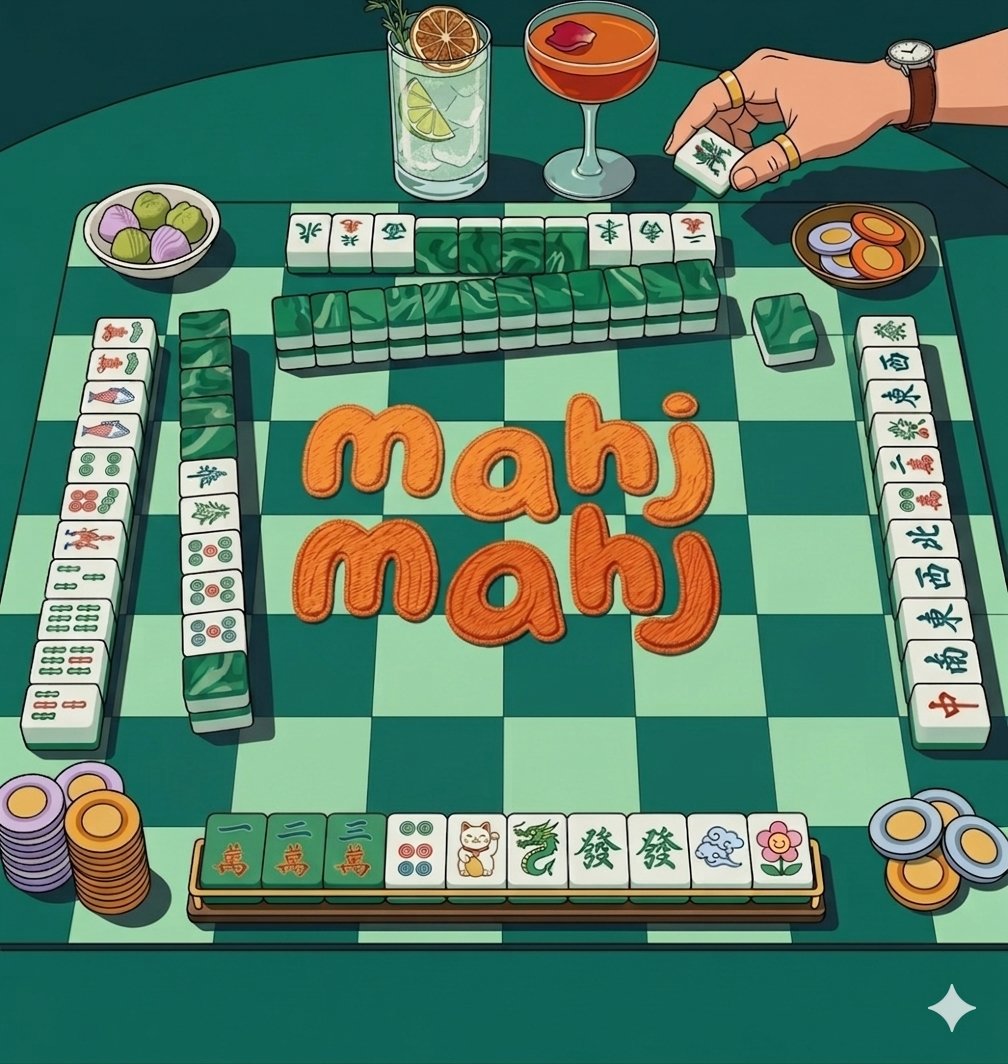
Chinese Taiwanese American
What is Mahj Mahj

Mahjong is not one game.
It is a world of games—ancient,
evolving, and more alive than ever.

Mahj Mahj is a modern learning platform for all three major Mahjong traditions. Learn the tiles, study the rules, drill your pattern recognition, and find your table—wherever it may be.

600M+Players worldwide
3Distinct traditions
50+Regional variants
1Place to learn them all

Three Worlds

Same tiles. Completely different games. Each tradition has its own rules, rhythm, and personality.

01 / Chinese

Chinese
Mahjong

The origin. The standard. The obsession.

Mahjong's ancestral form spans dozens of regional variants—from Hong Kong competition rules to Sichuan fast-play. It rewards memory, calculation, and the ability to read your opponents before they've finished their thought.

136 Tiles Regional Variants Point Scoring No Jokers
Explore Chinese Mahjong →
02 / Taiwanese

Taiwanese
Mahjong

Louder. Longer. Deeply social.

Played with 16 tiles per hand and a uniquely generous tenpai system. Taiwanese Mahjong is a social institution woven into daily life across Taiwan. Competitive and convivial in equal measure.

144 Tiles 16-Tile Hands Tenpai Rules Fang Pao
Explore Taiwanese Mahjong →
03 / American

American
Mahjong

A reinvention. Thriving on its own terms.

Introduced to America in the 1920s and evolved ever since. Joker tiles, the annual NMJL card, the Charleston passing ritual, and a completely different winning hand structure. Not simplified—parallel.

152 Tiles 8 Jokers NMJL Card Charleston
Explore American Mahjong →
Chinese Mahjong

The Origin.
The Standard.

Chinese Mahjong is the ancestral form of the game — a family of rule sets spanning centuries of regional evolution. From Hong Kong competition play to Sichuan's fast-draw format, every variant shares the same core logic: build a complete hand before your opponents do. Understanding Chinese Mahjong is the foundation for understanding Mahjong at all.

136 Base Tiles 13-Tile Hands No Jokers Regional Rulesets

The Tile Set

The standard Chinese Mahjong set contains 136 tiles: 36 Bamboo (1–9 × 4), 36 Characters (1–9 × 4), 36 Dots (1–9 × 4), 16 Wind tiles (four directions × 4), and 12 Dragon tiles (three types × 4). There are no Jokers.

Many sets include 8 Flower and Season bonus tiles, bringing the total to 144. Whether Flowers are used — and how they score — depends on the regional rule set in play. When in doubt, ask before the first hand.

How a Winning Hand Works

A standard winning hand consists of 4 sets and 1 pair — 14 tiles total (13 held + 1 winning tile). Sets are built from three tile types: a Chow (three consecutive tiles in the same suit), a Pung (three identical tiles), or a Kong (four identical tiles, declared immediately and supplemented by a bonus draw). The pair must be two matching tiles. Most Chinese rule sets require exactly this 4+1 structure, though special hand exceptions exist in some systems.

Example winning hand — 4 sets + 1 pair = 14 tiles
🎋
3
🎋
4
🎋
5
Chow
+

7

7

7
Pung
+

2

3

4
Chow
+

E

E

E
Pung
+
Pair

Key Rules

Chow (吃) — Consecutive claim, positional only

A Chow completes a run of three consecutive tiles in the same suit. You may only claim a Chow from the player directly to your left — not from any other player at the table.

🎋
3
🎋
4
🎋
5
Three consecutive tiles in the same suit
Common Rule
Pung (碰) & Kong (槓) — From any player

A Pung — three identical tiles — can be claimed from any player's discard. A Kong — four identical tiles — must be declared the moment it is completed and earns a bonus draw from the dead wall.


7

7

7
Pung — 3 identical
·

9

9

9

9
Kong — 4 identical
Common Rule
Self-draw win (自摸 / Zì mō)

Winning by drawing your own tile means all three opponents each pay you individually — making it far more valuable than winning from a discard, where typically only the discarder pays.

HK-Style
Concealed hand bonus

Winning with a fully concealed hand — no exposed sets — earns a significant scoring multiplier in most rule systems. This rewards patience and careful tile management over speed.

Common Rule
Flower tiles (bonus draw)

When drawn, a Flower or Season tile is immediately revealed and set aside. You draw a replacement from the dead wall. Flowers score bonus points but do not contribute to hand structure.

House-Rule Dependent
Scoring varies by regional rule set

Hong Kong, Sichuan, MCR (Mahjong Competition Rules), and Riichi each use fundamentally different scoring systems. Establish which rule set is in play before a session — the point values, fan requirements, and payment structures are not interchangeable.

Red · Green · White — Honor tiles, never in Chows
HK-StyleMCRSichuan

Common Mistakes

Trying to Chow from any player

Chows are restricted to the discard of the player directly to your left. Pungs and Kongs can be claimed from anyone, but Chow is positional.

Forgetting to declare a Kong immediately

When you complete a Kong — by drawing a fourth matching tile or adding to an exposed Pung — you must declare it right away. Holding four identical tiles silently is not permitted and forfeits the bonus draw.

Undervaluing a concealed hand

New players often expose sets for speed. In most Chinese rule systems, a concealed win earns a multiplier that can dramatically outpace an exposed hand — patience is often the higher-value play.

Discarding without reading the discard pile

The discard pile is a live map of what tiles are no longer available. Feeding a tile that completes an opponent's hand is the game's most avoidable mistake — and the most punishing.

Test your Chinese Mahjong knowledge with a quick drill

Practice Chinese Drills →
Taiwanese Mahjong

Louder. Longer.
Deeply Social.

Taiwanese Mahjong is not a simplified Chinese variant — it is a fully distinct system with its own hand size, scoring logic, and social customs. Played with 16-tile hands and a tenpai payment structure that rewards near-completion, it is simultaneously more forgiving and more consequential than its Chinese counterpart.

144 Tiles 16-Tile Hands Tenpai Payments Fang Pao

The Tile Set

Taiwanese Mahjong uses 144 tiles: the standard 136-tile base (Bamboo, Characters, Dots, Winds, Dragons) plus 8 Flower and Season bonus tiles. There are no Joker tiles.

Each player begins with 16 tiles — three more than in Chinese Mahjong's standard 13. The larger hand creates more possible combinations and generally longer, more layered sessions. Flower and Season tiles are drawn and set aside immediately for bonus points, with a replacement drawn from the dead wall.

How a Winning Hand Works

A winning hand in Taiwanese Mahjong consists of 5 sets and 1 pair — 16 tiles total (the 16-tile starting hand includes the winning tile). Sets follow the same logic as Chinese Mahjong: Chows (three consecutive suited tiles), Pungs (three identical tiles), and Kongs (four identical tiles). The pair must be two matching tiles. The added 5th set — compared to Chinese Mahjong's 4+1 — reflects the larger hand size and adds more strategic latitude.

Example winning hand — 5 sets + 1 pair = 17 tiles (16-tile hand)
🎋
1
🎋
2
🎋
3
Chow
+

4

5

6
Chow
+

8

8

8
Pung
+

S

S

S
Pung
+
🎋
7
🎋
8
🎋
9
Chow
+
Pair

Key Rules

16-tile hand structure

Each player holds 16 tiles at all times (before winning). This is 3 more than standard Chinese Mahjong. The result is a slower, more complex game with more viable hand directions at any given moment.

Taiwanese 16-Tile
Chow restriction — still positional

Despite the larger hand and some structural differences, Chow claims remain restricted to the next player in turn order — the same rule as Chinese Mahjong. Any player may claim a discard to win (Hu), Pung, or Kong, but only the player whose turn comes next may call Chow.

Common Rule
Tenpai payments at round end

If the wall runs out without anyone winning, players in tenpai (one tile from winning) receive a payment from each player who is not in tenpai. This means pursuing tenpai has value even when a full win seems out of reach.

Taiwanese 16-Tile
Fang Pao (放炮) — discarder pays alone

When you deal into an opponent's winning hand, you pay the full winning amount by yourself. Unlike many Chinese variants where all players share the payout, Fang Pao places full financial responsibility on the discarder — making every late-game discard a high-stakes decision.

Taiwanese 16-Tile
Flower / Season tile handling

Flower and Season tiles are drawn and immediately set aside face-up. A replacement tile is drawn from the dead wall. They contribute bonus tái to your score when you win but are not part of the hand structure.

🌸
🍂
🌺
Drawn → set aside face-up → draw replacement from dead wall
Taiwanese 16-Tile
Tái (台) scoring units

Winning hands are evaluated in tái — scoring units agreed upon before the game. Each hand has a base tái value; specific patterns, bonus tiles, and conditions add more. Payment = total tái × the agreed per-tái value. House rules vary widely on minimum tái requirements to win.

Taiwanese 16-TileHouse-Rule Dependent

Common Mistakes

Assuming any player can Chow

This is the most common cross-variant confusion. Chow is restricted to the next player in turn order in Taiwanese Mahjong — the same rule as Chinese. Only Hu, Pung, and Kong are open to all players.

Abandoning tenpai when winning seems unlikely

Tenpai pays at round end even if someone else wins first. Staying in tenpai — even with no clear win path — still earns you a payment from every non-tenpai player.

Underestimating Fang Pao risk on late discards

In the late game, when multiple players are likely approaching tenpai, every discard carries Fang Pao risk. Discarding without reading the board at this stage is how sessions are lost.

Miscounting in a 16-tile hand

Players transitioning from Chinese Mahjong frequently miscount. A valid 16-tile Taiwanese hand needs 5 sets + 1 pair. If you're trying to win with 4 sets + 1 pair, your hand is incomplete.

Test your Taiwanese Mahjong knowledge with a quick drill

Practice Taiwanese Drills →
American Mahjong

A Reinvention.
On Its Own Terms.

American Mahjong arrived in the 1920s and evolved into something genuinely distinct — not a simplified Chinese variant, but a parallel game with its own structure, wild tiles, annual hand card, and passing ritual. It is one of the most socially embedded games in American Jewish and broader social culture, with millions of active players. Understanding it requires setting aside the traditional 4+1 framework entirely.

152 Tiles 8 Jokers NMJL Card The Charleston

The Tile Set

An American Mahjong set contains 152 tiles: the standard 144-tile base (Bamboo, Characters, Dots, Winds, Dragons, Flowers/Seasons) plus 8 Joker tiles. The Jokers are the single most strategically significant element of the game — and the element most unlike any other Mahjong variant.

Jokers can substitute for any suited tile in a set of three or more identical tiles. They cannot form pairs. When a Joker is in an exposed set, any player holding the actual tile it represents may swap it out on their turn and claim the Joker for their own hand.

How a Winning Hand Works

American Mahjong does not use the traditional 4 sets + 1 pair structure. Winning hands are defined exclusively by the current year's NMJL card — a published list of valid hand patterns that changes annually. Hands may require specific combinations of Pungs, Kongs, Quints (five identical tiles using Jokers), pairs, singles, and runs as defined on the card. You cannot invent hands. You cannot use hands from previous years' cards. The card is the game.

Example NMJL hand pattern — 1s and Flowers
🌸
🌸
JOKER
JOKER
Kong (2 Jokers)
+

1

1

1
Pung
+
🎋
1
🎋
1
🎋
1
Pung
+

1

1
Pair

Key Rules

The Charleston — mandatory tile exchange

Before the first draw, all players pass three tiles to the right, then three across, then three to the left. A second Charleston may follow. This pre-hand ritual shapes strategy before a single tile is drawn and is unique to American Mahjong.

The Charleston — 3 mandatory passes
Pass 1
3 tiles → Right
Pass 2
3 tiles → Across
Pass 3
3 tiles → Left
Then optionally repeat. Unique to American Mahjong.
NMJL
Joker rules — substitute, not wild

Jokers substitute only in sets of three or more identical tiles (Pungs, Kongs, Quints). They cannot be used in pairs, runs, or singles. A Joker in an exposed set can be claimed by any player who places the real matching tile in its position — on their turn.


3

3
JOKER
Joker substitutes in a Pung — valid ✓
JOKER
Joker in a pair — NOT valid
NMJL
Exposures and calling tiles

When you claim a discard to complete an exposed set, you must call it clearly and immediately place the set face-up on your side of the table. You must also discard a tile to maintain the correct hand count. Exposures reveal your hand direction — choose them deliberately.

NMJL
No Chows in the traditional sense

American Mahjong does not use the Chow (consecutive run) mechanic as a claimable set type. Hand patterns — including any runs that may appear — are defined by the NMJL card and claimed only in the context of completing a valid card hand.

NMJL
Wall game — no payment, hand replayed

If all tiles are drawn and no one wins, the hand is a wall game. No money changes hands and the hand is redealt. This differs from Taiwanese Mahjong, where tenpai players receive payments from non-tenpai players at round end.

NMJL

The Annual NMJL Card

The single most important element of American Mahjong

Each year, the National Mah Jongg League publishes a new card listing all valid winning hands for that year. To win, your hand must exactly match one of the hands on the current card — tile for tile, set for set. Hands from prior years are no longer valid once the new card is released.

The card typically lists 50–60 hands organized into categories. Each hand specifies the exact tile types, quantities, and structure required. Some hands are worth more than others (singles vs. doubles), and some require specific suits or honor tiles. None can be substituted or approximated.

New cards are typically released in late March or early April. Serious players study the new card before the season begins — memorizing available hands, identifying which suit patterns work given your tiles, and tracking which hands opponents may be building from their exposures.

Card memorization is a skill in its own right. Players who know the card deeply can play faster, read opponents more accurately, and make better discard decisions throughout the hand.

Common Mistakes

Trying to use a Joker in a pair

Jokers can only substitute in sets of three or more identical tiles. A pair must be two real matching tiles. This is one of the most frequently misremembered rules, especially for new players.

Not studying the current year's NMJL card

Playing American Mahjong without knowing the current card is like playing poker without knowing which hands beat which. The card changes every year — what won last season may not be valid this season.

Exposing sets too early

Every exposure reveals part of your intended hand to all other players. Skilled opponents will adjust their discards accordingly. Expose only when necessary — and be aware of what your exposures communicate.

Forgetting that Jokers in exposed sets can be taken

Any player holding the actual tile that a Joker represents can swap it out of your exposed set on their turn. Hands built heavily on exposed Jokers are vulnerable. Always track where your Jokers are sitting.

Test your American Mahjong knowledge with a quick drill

Practice American Drills →
The Tile Families

Learn to read
the table.

Every Mahjong set is built from the same core tile families. Understanding what each tile is, and what it means, is step one.

American Mahjong adds one element no other variant uses: the Joker tile—a wild card that can substitute for any suited tile in a valid hand, making it the most powerful and most contested tile on the table.

🎋

Bamboo (Bam)

Tiles 1–9, depicted with bamboo stalks. The 1-Bam traditionally features a bird or peacock. One of the three numbered suits.

Characters (Crak)

Tiles 1–9, marked with Chinese number characters and a red 万 symbol. Bold and immediately recognizable.

Dots (Circle)

Tiles 1–9, represented by circles or coin-like discs. The third numbered suit. Clean and geometric.

🧭

Winds

Four Honor tiles: East 東, South 南, West 西, North 北. They form Pungs and Kongs, never Chows.

🀄

Dragons

Three Honor tiles: Red (中), Green (發), White (白). High-scoring in most variants when collected in sets of three.

🌸

Flowers & Seasons

Bonus tiles in Chinese and Taiwanese variants. Drawn and immediately set aside—they score points but don't count toward hand structure.

Joker — American Mahjong Only

Eight wild tiles. A Joker can stand in for any suited tile in a set of three or more identical tiles. It cannot form a pair. If exposed, any player holding the matching tile can swap it out—making Joker management one of the most strategic elements in the game.

Sample tiles — hover to examine
🎋
1
🎋
5
🎋
9
Bamboo
·

1

5

9
Character
·

1

5

9
Dot
·

E

S
西
W

N
Winds
·
Dragons
·
🌸
🍂
Flowers
·
JOKER
Joker*

*Jokers appear exclusively in American Mahjong sets.

Play Smarter

Strategy &
Fundamentals

Good Mahjong is part memory, part math, and part psychology. These principles apply whether you're playing at a kitchen table in Brooklyn or a game room in Taipei.

"A player who chases every hand wins none of them."

— Common Mahjong proverb
Practice with Drills
01

Build toward a hand, not away from one

The most common beginner mistake is discarding reactively—defending against opponents instead of pursuing your own winning hand. Pick a structure early. Commit. A focused incomplete hand usually beats a scattered defensive one.

All Variants
02

Watch the discards like a map

The discard pile is a live record of what's no longer in play. Tiles opponents toss early tell you what they don't need. Tiles they stop discarding tell you what they're building. Read both signals continuously.

All Variants
03

Understand tile density

There are four of every numbered tile. As tiles leave the table, your mental map of what's live changes in real time. Tracking the count isn't cheating—it's the game.

All Variants
04

American: the Joker trap

Jokers can be swapped out of exposed sets. Hands that rely entirely on Jokers are vulnerable. Build locked pairs—Jokers can't make those—so your hand has structural protection.

American
05

Taiwanese: don't abandon tenpai

Reaching tenpai earns a payment from non-tenpai players at round end—even if someone else wins first. A near-complete hand is still worth something.

Taiwanese
06

Know which game you're playing

A hand that wins in Chinese Mahjong may not be valid in American. The winning conditions across all three traditions are genuinely different. The rules are not interchangeable.

All Variants
07

Chinese: concealed hands score more

In most Chinese Mahjong variants, winning with a fully concealed hand earns a significant scoring bonus. Sometimes the slow, patient hand is the right one.

Chinese
Quick Drills

Build fluency.
One tile at a time.

Mahj Mahj drills are fast, focused, and deliberately repetitive. We surface the rules and patterns you need to internalize—and bring them back until they stick.

Choose your answer before seeing the result. Every question gives you feedback and context. Switch decks to cover all three variants.

🀄American8 cards
🀇Chinese8 cards
🀙Taiwanese8 cards
1 / 8

Loading...

0Correct
0Seen
8Remaining
Find Your Table

Games, Events
& Lessons

Discover what's happening in the Mahjong world—locally and online. From neighborhood game nights to national tournaments.

Type
City
Tournament

NYC Open Mah Jongg Classic

The city's largest American Mahjong tournament. Open to all skill levels — NMJL card required. Two full days, real prizes, and the kind of focused competition that sharpens your game.

📅 April 18–19, 2026📍 Chelsea, New York City🎟 Registration open
Lesson

Intro to Chinese Mahjong — Chinatown

Weekly beginner sessions covering HK-style rules, hand structure, and reading the discard pile. Sets provided.

📅 Every Saturday, April–May📍 Chinatown Community Center, NYC🎟 $20 / session
Game Night

Brooklyn Mahjong Night — All Variants

Bi-weekly gathering for players of all skill levels. Chinese, American, and Taiwanese tables most nights. Bring your set or borrow one.

📅 Every other Friday📍 Bushwick, Brooklyn🎟 Free — first timers welcome
Tournament

West Coast American Mahjong Open

📅 May 10–11, 2026📍 Koreatown, Los Angeles🎟 $65 entry — register by April 25
Lesson

Learn Taiwanese Mahjong — 4-Week Series

A structured introduction to 16-tile play, tenpai logic, Fang Pao, and tái scoring. Small groups, maximum 8 players per session.

📅 Wednesdays, May 2026📍 San Gabriel Valley, LA🎟 $80 for the series
Game Night

Taiwanese Mahjong Social — Richmond District

📅 April 10, 2026📍 Richmond District, San Francisco🎟 Free — RSVP required
Tournament

Pacific Rim Chinese Mahjong Open

Two-day MCR-format tournament. Open to all experience levels. Registration is competitive — spots fill fast each year.

📅 May 3–4, 2026📍 Japantown, San Francisco🎟 Registration opens April 1
Game Night

Chicago Mahjong Collective — Monthly Meet

📅 First Sunday of each month📍 Pilsen, Chicago🎟 $5 suggested donation
Lesson

American Mahjong for Beginners — Boston

📅 Thursdays, April–May 2026📍 Allston, Boston🎟 $25 / session or $80 series
Game Night

Miami Mah Jongg Club — Open Table

Weekly American Mahjong play in a relaxed setting. NMJL card in play. All skill levels welcome — experienced players happy to guide newcomers.

📅 Tuesdays, ongoing📍 Brickell, Miami🎟 Free — members and guests
Online

Learn American Mahjong from Zero

📅 Tuesdays, 7pm ET📍 Zoom — link on registration🎟 $35 for 4-week series
Online

Global Chinese Mahjong — Weekly Digital Play Session

Join players from across the US, Taiwan, and Hong Kong for relaxed online Chinese Mahjong. HK and MCR tables. All skill levels. No registration — just show up and find a table.

📅 Saturdays, 9am PT / 12pm ET📍 Mahjong Soul platform🎟 Free

Events are community-submitted and subject to change. Mahj Mahj does not organize or endorse specific events. Always verify details directly with organizers.

Submit Your Event
Mahjong in the News

The Conversation Is
Bigger Than the Table

Mahjong is having a cultural moment — not just as a game, but as a site of design, identity, community, and contested meaning. Here's what the broader conversation looks like.

Culture & Comeback

🎋
1
🎋
2
🎋
3
Culture

Mahjong Clubs Are Filling Rooms in Major US Cities

The past three years have seen a sharp acceleration in mahjong club formation across Brooklyn, LA, Chicago, and the Bay Area — driven by players in their 20s and 30s who discovered the game through family, social media, or both. These aren't your grandmother's church-hall sessions. They're weekly, ticketed, and increasingly competitive.

Community Trend · 2024–2026

1

5

9
Design

Tile Sets as Collectible Design Objects

Independent studios and luxury brands alike have entered the mahjong tile market, releasing ornate limited-edition sets at prices that have nothing to do with gameplay. The aesthetic of the game — the weight, the click, the iconography — has become as culturally legible as the game itself. A well-designed set is now a statement object.

Design Culture · 2024–2026
Viral

Mahjong Tutorial Content Is Pulling Millions of Views

On TikTok and YouTube, mahjong content regularly breaks through algorithmically. The game's visual language — colorful tiles, the tactile sounds of play, the drama of a winning hand — translates naturally to short-form video. For many younger players, this was their first encounter with the game. The table followed.

Social Media Trend · 2025

Etiquette, Adoption & Identity


1

8

9
Identity

The Mahjong Line and the Limits of Redesign

When The Mahjong Line launched in 2021 with redesigned, Westernized tile sets, it ignited one of the sharper cultural debates in the tabletop world. Critics — primarily Asian and Asian American voices — argued the redesign stripped cultural context for market appeal. The founders eventually engaged the criticism directly. The conversation it sparked has not fully resolved, and it probably shouldn't: it exposed real fault lines in how heritage objects travel across communities.

Cultural Commentary · 2021–Ongoing

E
西
W

S
Ownership

Who Owns Mahjong? The Answer Is Complicated

Mahjong has been genuinely adopted across cultures for over a century — Japanese riichi, American NMJL, and Taiwanese play are all real traditions, not distortions. But adoption and appropriation are not the same thing, and the difference shows most clearly in how communities are treated when they name the distinction. Enthusiasm for a culture's game is not the same as respect for the people who carry it.

Cultural Identity · Ongoing
🌸
🍂
🌺
Perspective

Heritage or Trend? Asian American Players Weigh In

For many Asian American players, mahjong is memory — grandparents, kitchens, languages half-remembered. The recent surge in mainstream interest has been received with genuine ambivalence: welcome visibility, but also real anxiety about what happens when a practice loaded with cultural meaning becomes a lifestyle accessory. The most honest accounts hold both feelings at once.

Community Perspectives · 2023–2025

Events & Community


7

8

9
Tournament

Competitive Mahjong in the US Is Growing Up

Organized American Mahjong tournaments have expanded significantly, with multi-day events now drawing hundreds of players in New York, Florida, and California. Chinese MCR tournaments are gaining traction in diaspora communities. The infrastructure for serious competitive play — rules, referees, prize structures — is finally catching up with the demand that's been building for years.

Tournament Scene · 2024–2026
🎋
5
JOKER

5
Digital

Online Platforms Are Making Mahjong Truly Global

Digital platforms — from Mahjong Soul to dedicated American-rules apps — have drawn millions of players and transformed the game's reach. For diaspora communities spread across continents, and for isolated enthusiasts in cities without local tables, online play has preserved traditions that geography would otherwise sever. The table is wherever you are.

Digital Play · 2023–2026

N
🎋
1
🌸
Heritage

Three Generations at One Table

The most consistent theme in mahjong community coverage is intergenerational play: grandparents teaching grandchildren, adult children learning their heritage through tiles they've touched since childhood. As younger players rediscover the game on their own terms, the kitchen-table ritual is finding new life — without losing the depth and intimacy that made it worth passing down in the first place.

Community & Heritage · 2024–2025